
Former Insiders Allege: Crypto Powerhouse Binance Commingled Customer Funds and Company Revenue: Reuters
According to three sources familiar with the matter who spoke to Reuters, Binance, the largest cryptocurrency exchange globally, mixed customer funds with company revenue during 2020 and 2021. This action violated financial regulations in the United States, which mandate the separation of customer funds from the company's finances.


Because Bitcoin
May 23, 2023
Reuters released a special report which states that the world's largest cryptocurrency exchange, Binance, has come under scrutiny for allegedly commingling customer funds with company revenue, violating U.S. financial regulations that mandate the separation of customer money. According to three sources familiar with the matter who spoke to Reuters, Binance mixed customer funds with company revenues in 2020 and 2021, with sums reaching into the billions of dollars. The commingling of funds reportedly occurred on a near-daily basis in accounts held by Binance at Silvergate Bank, a U.S. lender.
While Reuters could not independently verify the exact figures or frequency of the commingling, a bank record reviewed by the news agency revealed that on February 10, 2021, Binance combined $20 million from a corporate account with $15 million from an account that received customer funds. This practice raised concerns among three former U.S. regulators who noted a lack of internal controls at Binance to ensure the clear identification and segregation of customer funds from company revenues. The mixing of funds not only put client assets at risk but also obscured their whereabouts, making it difficult for customers to track their money.
Binance customers were led to believe that their dollar transfers were treated as deposits, as the company's website referred to them as such and assured users that their funds would be credited to their trading accounts. However, Binance spokesperson Brad Jaffe denied the commingling allegations, stating that the accounts in question were used to facilitate user purchases of the exchange's bespoke dollar-linked crypto-token, BUSD.
It is worth noting that there is no evidence to suggest that Binance lost or misappropriated customer funds. However, the commingling of customer and corporate funds can potentially lead to significant losses for clients, as was seen in the case of the collapsed FTX crypto exchange, where the founder was alleged to have commingled client funds for personal use.
Bank and company records, as well as interviews with former insiders, indicate that Binance relied heavily on Silvergate Bank for its financial operations. Company revenues were directed to the Silvergate account of Binance Holdings, the exchange's Cayman Islands holding firm, while customer dollars flowed into the Silvergate account of Key Vision Development, a firm controlled by Binance CEO Changpeng Zhao. Binance allegedly informed Silvergate that the purpose of the Key Vision account was to receive dollar deposits from non-U.S. customers, although Binance spokesperson Jaffe disputed this claim.
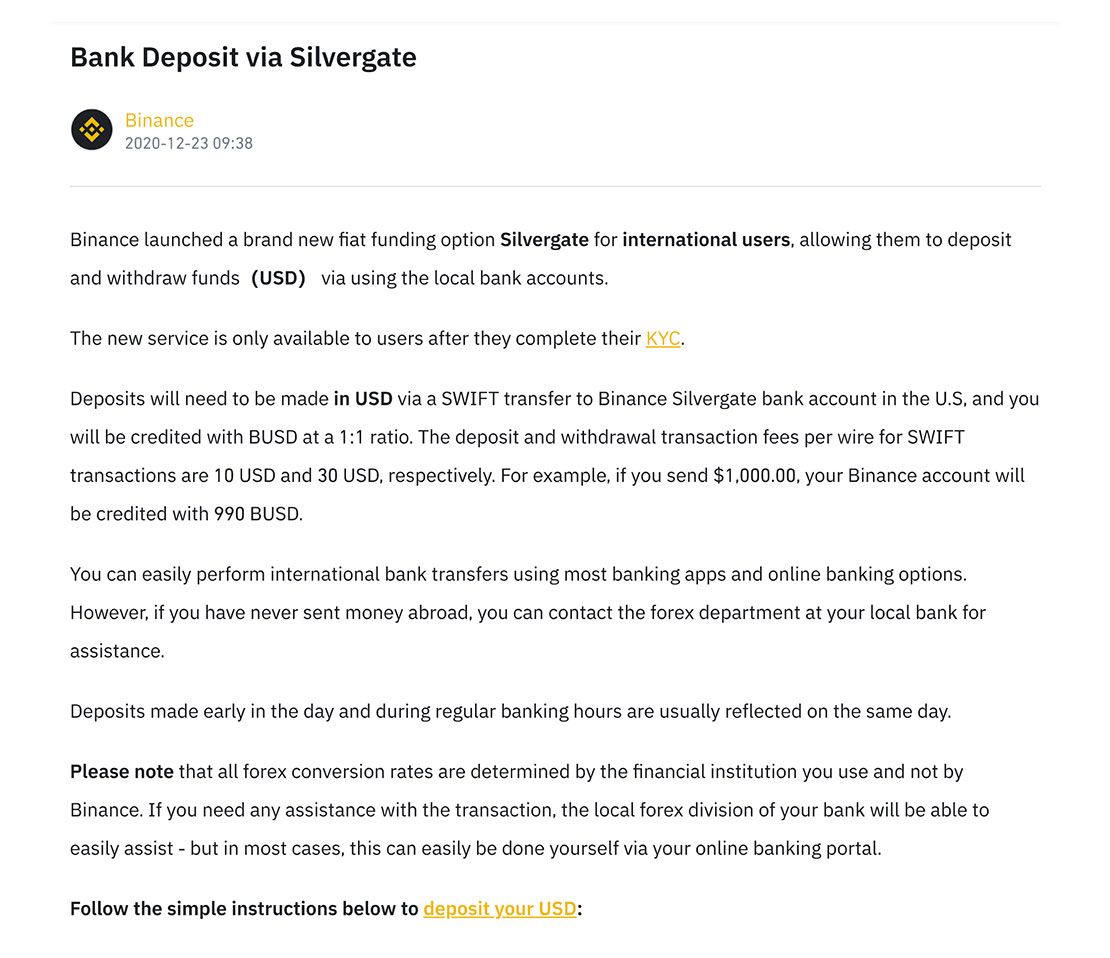
In December 2020, Binance's website featured a screenshot of instructions guiding users on depositing dollars into Silvergate Bank. Source: Reuters.
Furthermore, Binance's financial operations involved the use of a third Silvergate account, belonging to a Cayman Islands firm controlled by Zhao. According to a source familiar with Binance's group finances, money from this account was converted into the BUSD token. Binance's heavy reliance on Silvergate raised concerns among the former regulators, as it allowed the exchange to shield funds from tax authorities and potentially evade regulatory scrutiny.
Resources: